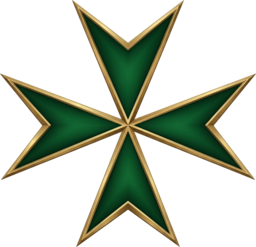
 Order of Saint Lazarus
 Origins
The Order of Saint Lazarus dates back to the time of the Crusader knights, founded at Jerusalem in the twelfth century and taking its name from Saint Lazarus, the patron of lepers. From its foundation its members have been dedicated to two ideals: aid to those suffering from leprosy, received in the leper-house outside the walls of the city — a refuge for those whom the world had marked as untouchable — and the defence of the Christian faith. Its brothers were knights bound by a single vow: to receive the sick, to feed the poor, and to bury the dead.
Through the centuries
With the fall of Acre in 1291 the Order departed the Holy Land, but its hospitals continued to open across Europe — in France, Spain, Italy, and the German lands. For seven centuries the Order endured crusades, plagues, suppressions and revolutions without ever fully ceasing its work. In the early twentieth century its modern restoration took shape under the Bourbon line, and today the Order is registered as a Foundation in Madrid, in accordance with the laws of Spain.
"An ancient order of chivalry which has adapted to remain relevant to twenty-first century concerns."
— Public statement of the Order, st-lazarus.net
The aims of the Order
- to preserve and defend the Christian faith;
- to support, care for and help the poor, the sick and the dying;
- to promote and maintain the principles of Christian chivalry; and
- to follow the teachings of Christ in all it does.
By its activities in the charitable, philanthropic, health and education fields, the Order contributes to the achievement of the aims and principles of the United Nations Charter and the Statute of the Council of Europe.
Today
Today the Order is an international, self-governing and independent body with its own Constitution — apolitical, ecumenical, and non-denominational. It is made up of approximately four thousand members on five continents, organised in forty-two jurisdictions across thirty-seven countries. Its work spans hospice and end-of-life care, services for those with Hansen's Disease, refugee and migrant aid, community support, child and family welfare, emergency relief and education.
The current Grand Master
Don Francisco de Borbón y Hardenberg is the fiftieth Grand Master in the line, invested in 2018. He carries the title Magister Ordinis and is the formal head of the Order's international leadership.
Calendar
Two days mark the rhythm of the Order's year. World Leprosy Day, the last Sunday of January, when the Order's earliest mission is renewed. And Saint Lazarus Day on 17 December, the patronal feast.
Motto
Atavis et Armis. By ancestors. By arms.